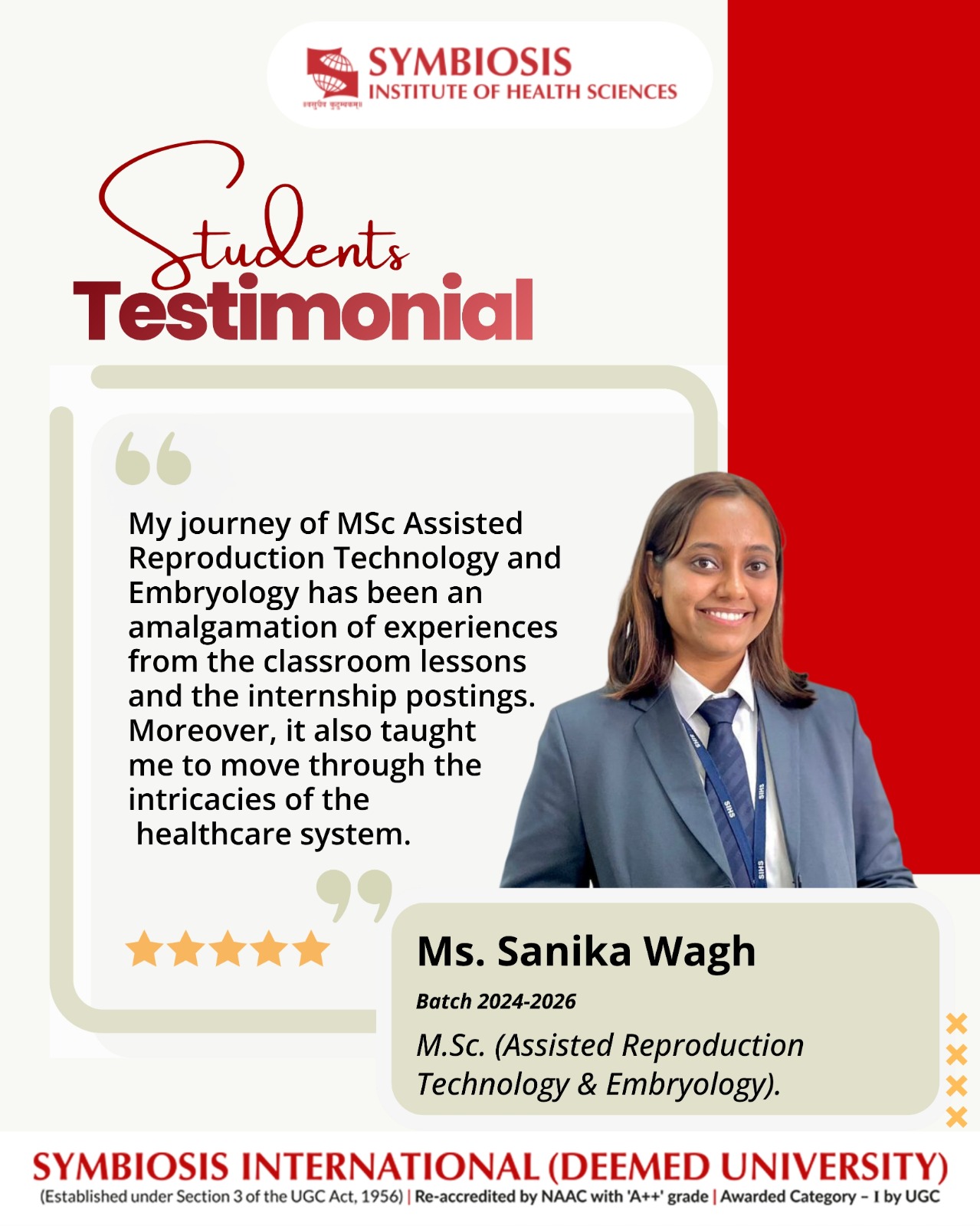
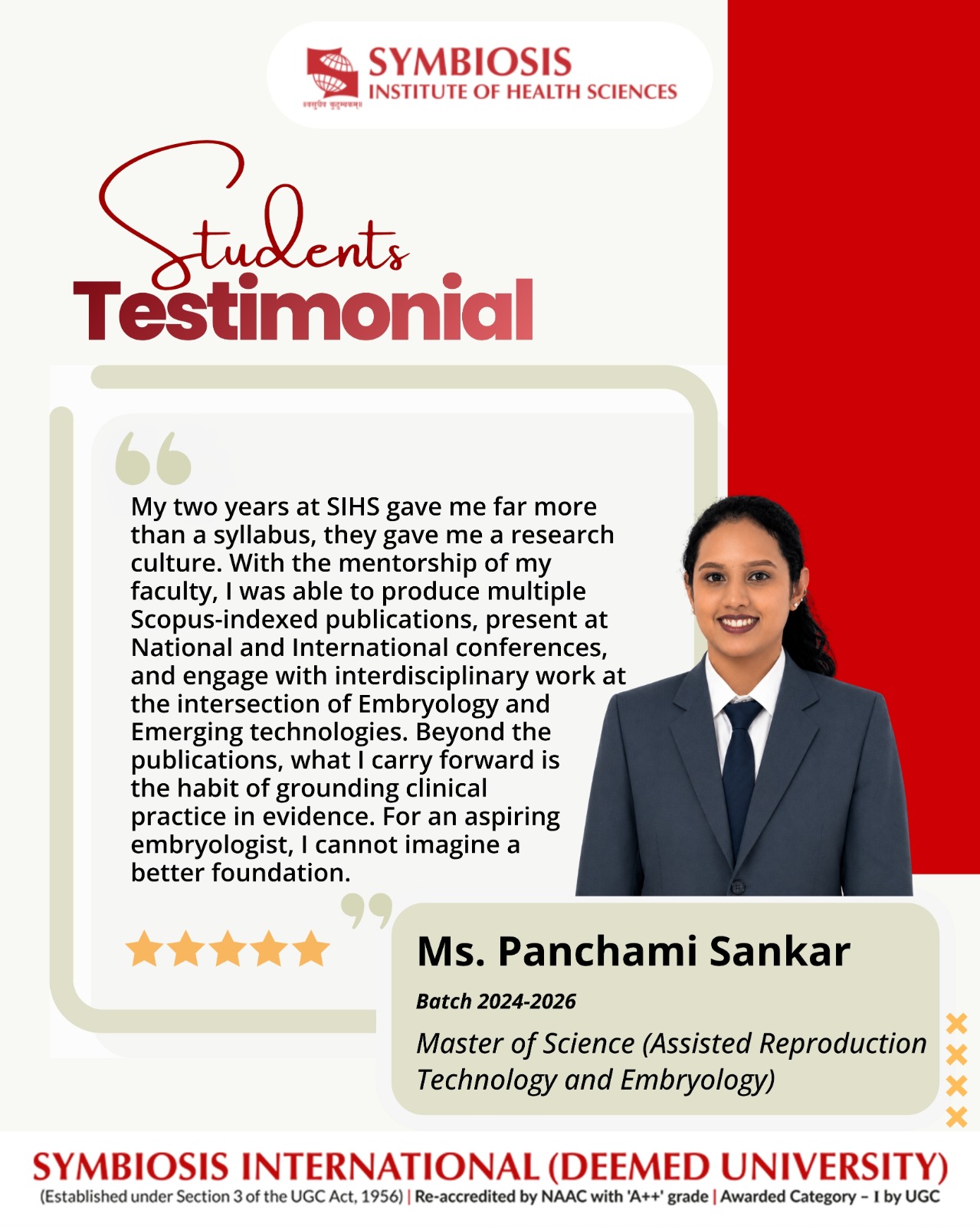
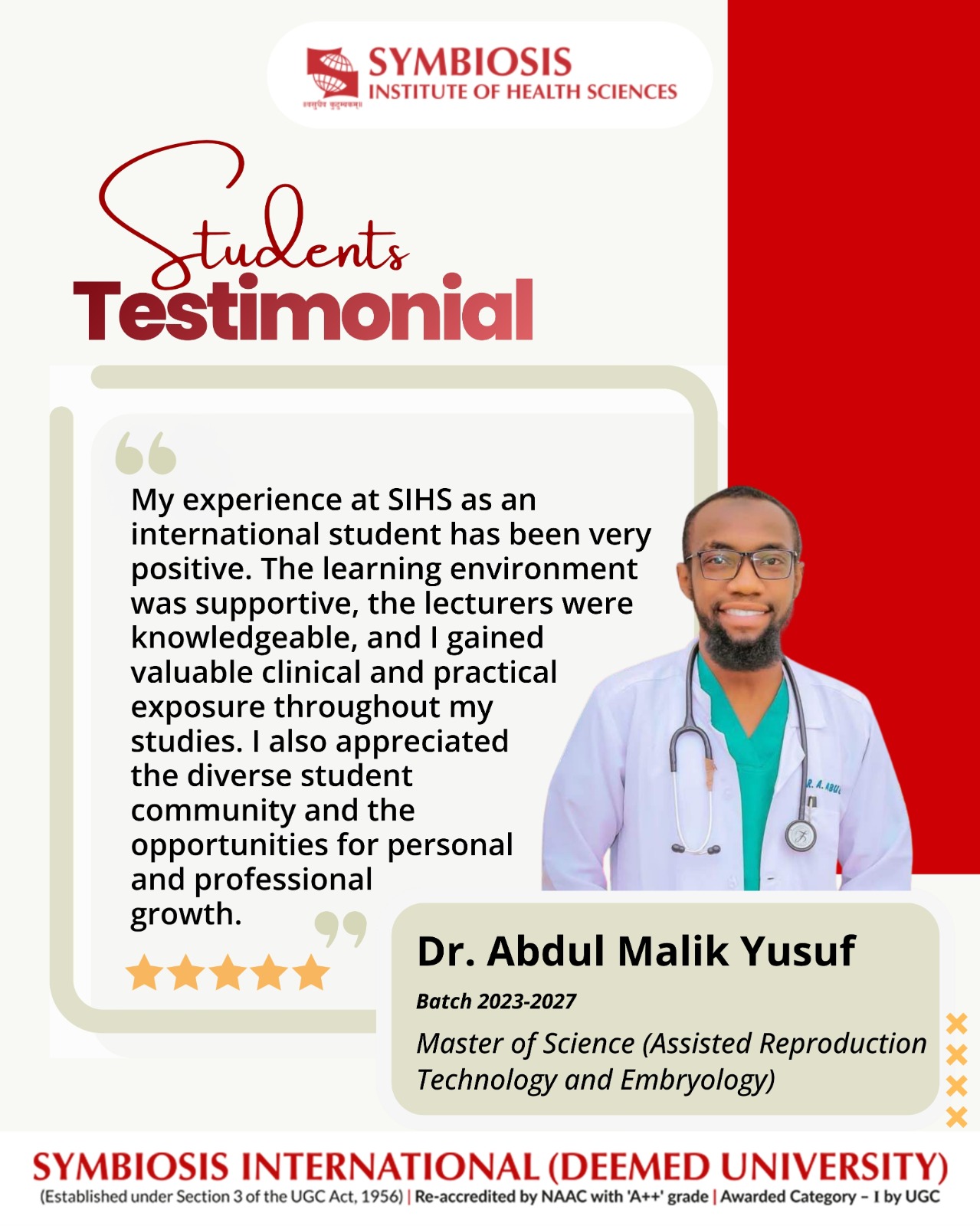
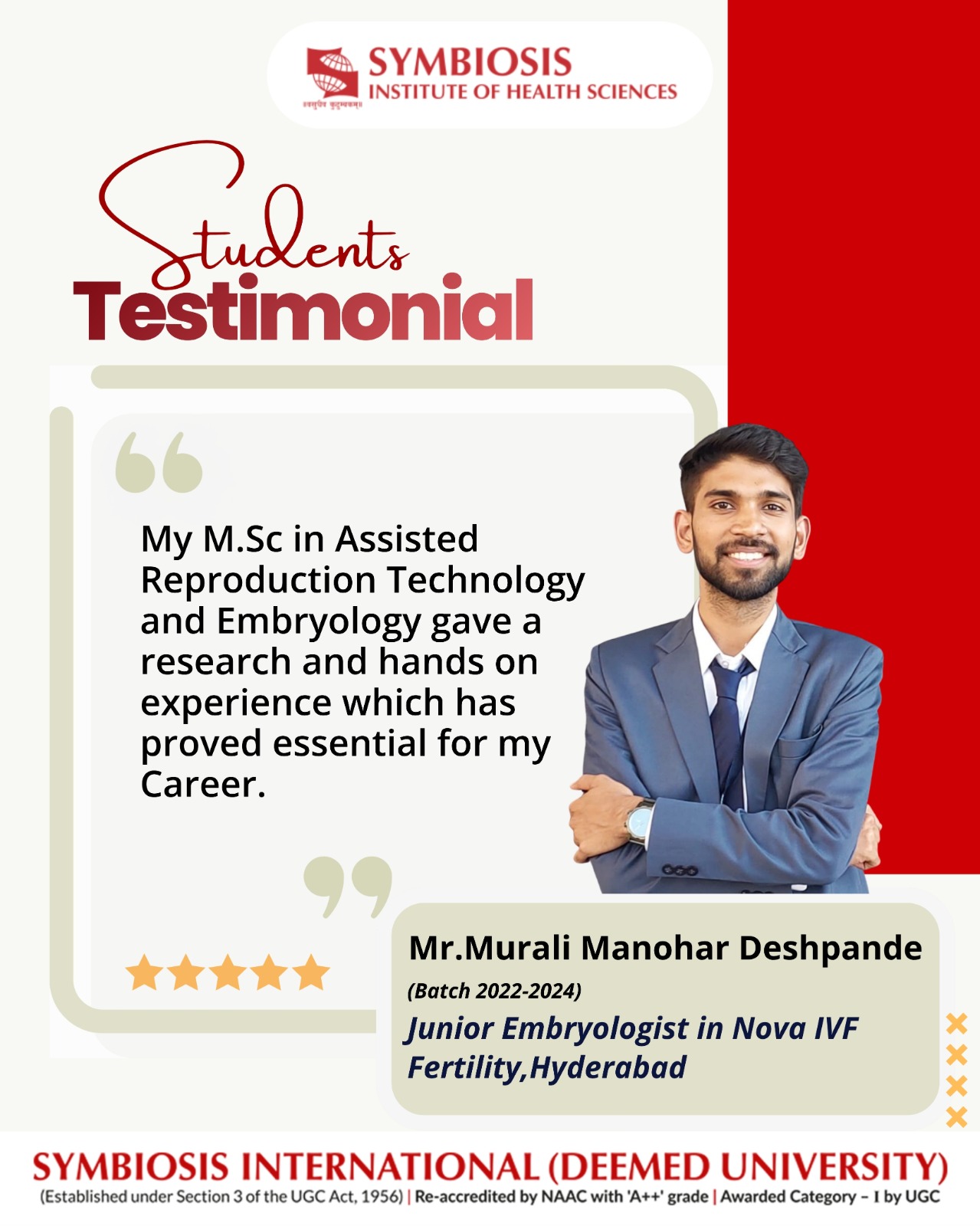
The Master of Science (Assisted Reproduction Technology and Embryology) programme will teach students about the technology that comes under embryology like Assisted Reproductive Technology (ART) is used to treat infertility. It includes fertility treatments that handle both a woman's egg and a man's sperm. It works by removing eggs from a woman's body. The eggs are then mixed with sperm to make embryos in the laboratory by embryologists.
The scarcity of experienced embryologists with respect to the rising cases of infertility has created a high demand for such specialists trained by clinical embryology courses in Pune.
The Master of Science (Assisted Reproduction Technology and Embryology) and Assisted Reproduction Technology programme aims to develop well-trained and skilled embryologists by keeping them up-to-date with relevant technologies in the field. Students of clinical embryology courses are trained through a diverse set of pedagogical practices. Students of Master of Science (Assisted Reproduction Technology and Embryology) obtain in-depth lab training in the cutting-edge techniques such as oocyte collection, semenology techniques, in vitro fertilization (IVF), cryopreservation, and more. The only clinical embryology courses in Pune offered by Symbiosis provides robust training in Research Methodologies and Dissertation enables the students to achieve a career in the Research & Development.
The Master of Science (Assisted Reproduction Technology and Embryology), is a two years’ full time degree programme, conducted by the SIHS, is a distinctive expertise and proficiency oriented programme. After completion of the programme, students will be able to work as Clinical Embryologists in public and private hospitals, In Vitro Fertility (IVF) centres / assisted reproductive clinics; as research scientists in fertility treatment and reproductive research.
The Master of Science (Assisted Reproduction Technology and Embryology) programme trains students in advanced Assisted Reproductive Technology (ART) and embryology, combining in-depth theoretical knowledge with hands-on lab experience in techniques like oocyte retrieval, IVF, cryopreservation, and semenology. With rising infertility cases and a shortage of skilled embryologists, graduates are well-prepared for diverse roles in clinical, research, and academic settings.
Global Career Opportunities:
English
The assessment of the student for each examination is done, based on relative performance. Maximum Grade Point (GP) is 10 corresponding to O (Outstanding). For all courses, a student is required to pass both internal and external examination separately with a minimum Grade Point of 4 corresponding to Grade P. Students securing less than 40% absolute marks in each head of passing will be declared FAIL. The University awards a degree to the student who has achieved a minimum CGPA of 4 out of maximum 10 CGPA.
The SIU will award Master of Science (Assisted Reproduction Technology and Embryology) at the end of semester IV examination by taking into consideration the performance of all semester examinations after obtaining minimum 4.00 CGPA out of 10 CGPA.
A detailed grade sheet and transcript will be issued to each successful student.
| Catalog Course Code | Course Code | Course Title | Credits | Internal Marks | External Mark | Internal Practical Marks | External Practical Marks | Total Marks | |
|---|---|---|---|---|---|---|---|---|---|
|
TH4353 |
0401460101 |
Reproductive Anatomy & Physiology |
4 |
120 |
40 |
0 |
40 |
200 |
|
|
T4829 |
0401460102 |
Biochemistry |
3 |
90 |
40 |
0 |
20 |
150 |
|
|
T4768 |
0401460103 |
Cell and Molecular Biology |
3 |
90 |
40 |
0 |
20 |
150 |
|
|
TH4354 |
0401460104 |
Reproductive Disorders |
3 |
90 |
40 |
0 |
20 |
150 |
|
|
T4004 |
0401460105 |
Biostatistics & Basic Epidemiology |
2 |
60 |
40 |
0 |
0 |
100 |
|
|
T2225 |
0401460106 |
Research Methodology |
2 |
60 |
40 |
0 |
0 |
100 |
|
|
TH4356 |
0401460107 |
Semenology Techniques-I |
2 |
0 |
0 |
0 |
100 |
100 |
|
|
SMC001 |
0401460108 |
Vasudhaiva Kutumbakam * |
0 |
0 |
0 |
0 |
0 |
Mandatory Non-Credit Course |
|
|
Total |
19 |
510 |
240 |
0 |
200 |
950 |
|||
| Catalog Course Code | Course Code | Course Title | Credits | Internal Marks | External Mark | Internal Practical Marks | External Practical Marks | Total Marks |
|---|---|---|---|---|---|---|---|---|
|
T4498 |
0401460108 |
IT Applications for Allied Health Care |
1 |
50 |
0 |
0 |
0 |
50 |
|
T4499 |
0401460109 |
Medical Physics |
1 |
50 |
0 |
0 |
0 |
50 |
|
T4575 |
0401460110 |
Research Proposal Writing |
1 |
50 |
0 |
0 |
0 |
50 |
|
Total Required Credits |
1 |
50 |
0 |
0 |
0 |
50 |
||
| Catalog Course Code | Course Code | Course Title | Credits | Internal Marks | External Mark | Internal Practical Marks | External Practical Marks | Total Marks |
|---|---|---|---|---|---|---|---|---|
|
TH4087 |
0401460201 |
Review of Literature |
4 |
0 |
0 |
0 |
200 |
200 |
|
TH4346 |
0401460202 |
Developmental Biology |
3 |
90 |
40 |
0 |
20 |
150 |
|
TH4348 |
0401460203 |
Instrumentation in Assisted Reproduction (ART) & Embryology |
3 |
90 |
40 |
0 |
20 |
150 |
|
T2216 |
0401460204 |
Business Statistics |
2 |
60 |
40 |
0 |
0 |
100 |
|
T4023 |
0401460205 |
Pathology and Case Presentation-I |
2 |
60 |
0 |
0 |
40 |
100 |
|
T2560 |
0401460206 |
Principles and Practices of Management |
2 |
60 |
40 |
0 |
0 |
100 |
|
TH4357 |
0401460207 |
Semenology Techniques- II |
2 |
0 |
0 |
0 |
100 |
100 |
|
TH4462 |
0401460208 |
Nutrition and Fertility |
1 |
50 |
0 |
0 |
0 |
50 |
|
TH4488 |
0401460209 |
Pharmacology in Gynaecological Disorders |
1 |
50 |
0 |
0 |
0 |
50 |
|
TH4788 |
Health and Wellness Module I # |
0 |
0 |
0 |
0 |
0 |
Mandat ory Non-Cr edit Course |
|
|
Total |
20 |
460 |
160 |
0 |
380 |
1000 |
||
| Catalog Course Code | Course Code | Course Title | Credits | Internal Marks | External Mark | Internal Practical Marks | External Practical Marks | Total Marks |
|---|---|---|---|---|---|---|---|---|
|
T4438 |
0401460211 |
Computer Language |
1 |
50 |
0 |
0 |
0 |
50 |
|
T4501 |
0401460212 |
Emerging Trends in Allied Health Care |
1 |
50 |
0 |
0 |
0 |
50 |
| Catalog Course Code | Course Code | Course Title | Credits | Internal Marks | External Mark | Internal Practical Marks | External Practical Marks | Total Marks |
|---|---|---|---|---|---|---|---|---|
|
TH4355 |
0401460301 |
Semen Washing Techniques |
3 |
90 |
40 |
0 |
20 |
150 |
|
TH4345 |
0401460301 |
Cytogenetics |
3 |
90 |
40 |
0 |
20 |
150 |
|
TH4490 |
0401460303 |
Procedures used in Assisted Reproduction Technology |
3 |
90 |
40 |
0 |
20 |
150 |
|
T4043 |
0401460304 |
Pathology and Case Presentation-II |
2 |
60 |
0 |
0 |
40 |
100 |
|
T4497 |
0401460305 |
Teaching Methodology - I |
2 |
60 |
0 |
0 |
40 |
100 |
|
TH4340 |
0401460306 |
Applied Management in Embryology Clinic |
2 |
60 |
0 |
0 |
40 |
100 |
|
TH4489 |
0401460307 |
Follicle Monitoring and Stimulation Protocols |
1 |
50 |
0 |
0 |
0 |
50 |
|
T4903 |
0401460308 |
Summer Internship |
3 |
0 |
0 |
0 |
150 |
150 |
|
TH4789 |
Health and Wellness Module II # |
0 |
0 |
0 |
0 |
0 |
0 |
|
|
SMC003 |
0401460309 |
Health and Wellness * |
0 |
0 |
0 |
0 |
0 |
Mandat ory Non-Cr edit Course |
|
Total |
19 |
500 |
120 |
0 |
330 |
950 |
||
| Catalog Course Code | Course Code | Course Title | Credits | Internal Marks | External Mark | Internal Practical Marks | External Practical Marks | Total Marks | |
|---|---|---|---|---|---|---|---|---|---|
|
T4506 |
0401460310 |
Innovation and Entrepreneurship |
1 |
50 |
0 |
0 |
0 |
50 |
|
|
T4801 |
0401460311 |
Community Project |
1 |
50 |
0 |
0 |
0 |
50 |
|
|
Total Required Credits |
1 |
50 |
0 |
0 |
0 |
50 |
|||
| Catalog Course Code | Course Code | Course Title | Credits | Internal Marks | External Mark | Internal Practical Marks | External Practical Marks | Total Marks |
|---|---|---|---|---|---|---|---|---|
|
TH4344 |
0401460401 |
Counselling in infertility |
3 |
90 |
40 |
0 |
20 |
150 |
|
T4703 |
0401460402 |
Dissertation |
3 |
0 |
0 |
0 |
150 |
150 |
|
TH4347 |
0401460403 |
Ethics, Legal Aspects in Assisted Reproduction (ART) & Embryology |
3 |
90 |
40 |
0 |
20 |
150 |
|
T4902 |
0401460404 |
On Job Training |
2 |
0 |
0 |
0 |
100 |
100 |
|
T4061 |
0401460405 |
Pathology and Case Presentation-III |
2 |
60 |
0 |
0 |
40 |
100 |
|
TH4351 |
0401460406 |
Quality Assurance, Standardization & Accreditation (Assisted Reproduction & Embryology) |
2 |
60 |
40 |
0 |
0 |
100 |
|
TH4352 |
0401460407 |
Recent advances in Assisted Reproduction (ART) & Embryology |
2 |
60 |
40 |
0 |
0 |
100 |
|
TH4163 |
0401460408 |
Telemedicine Technology |
2 |
60 |
0 |
0 |
40 |
100 |
| Semester | Internal Credits | External Credits | Total Credits | Total Marks |
|---|---|---|---|---|
| Semester 1 | 1 | 19 | 20 | 1000 |
| Semester 2 | 3 | 18 | 21 | 1050 |
| Semester 3 | 2 | 18 | 20 | 1000 |
| Semester 4 | 0 | 19 | 19 | 950 |
| Total | 6 | 74 | 80 | 4000 |
30 seats
| Category | Sub Category | Reservation |
|---|---|---|
| I. Within the Sanctioned Intake | SC (In Percentage) | 15% |
| ST (In Percentage) | 7.5% | |
| Differently Abled (In Percentage) | 3% | |
| II. Over and Above the Sanctioned Intake | Kashmiri Migrants (In Seats) | 2 |
| International Students (In Percentage) | 25% |
Teaching in the M.Sc. Assisted Reproduction Technology & Embryology programme is structured to develop advanced theoretical knowledge, specialized laboratory competence, research aptitude, and professional ethics required in modern reproductive medicine and fertility care services. The programme integrates academic learning with clinical exposure in Assisted Reproduction Technology (ART) laboratories and associated healthcare institutions. Through a competency-based approach, students gain expertise in embryology techniques, fertility assessment, and advanced reproductive technologies while developing the professional standards required to function effectively in IVF and reproductive research environments.
At the commencement of the programme, postgraduate students undergo a structured orientation designed to prepare them for specialized training in assisted reproduction and clinical embryology laboratories. The orientation focuses on transitioning students toward professional practice in fertility care and laboratory-based reproductive technologies. The orientation includes:
This orientation ensures that students are well prepared to undertake responsible, ethical, and technically proficient roles within ART laboratories and reproductive healthcare settings.
The M.Sc. Assisted Reproduction Technology & Embryology programme integrates academic instruction, intensive experiential training, industry exposure, and structured research experience to develop highly skilled embryologists capable of working in advanced fertility laboratories.
Students receive comprehensive theoretical instruction through interactive lectures, seminars, group discussions, case studies, and student presentations. The curriculum covers reproductive biology, embryology, infertility management, semenology, IVF laboratory techniques, cryobiology, quality assurance in ART laboratories, and emerging reproductive technologies. Both synchronous and asynchronous learning methods are used to enhance knowledge acquisition and promote critical thinking.
A major component of the programme focuses on extensive experiential learning in Assisted Reproduction Technology laboratories. Students gain practical expertise in procedures such as oocyte handling and assessment, semen analysis and preparation techniques, in vitro fertilization procedures, embryo culture and grading, and cryopreservation techniques. Training emphasizes accuracy, laboratory protocols, sterility, and quality assurance practices required for successful fertility treatment outcomes.
Students participate in case discussions, clinical interactions, and fertility evaluation procedures that allow them to understand patient-centered fertility management. Exposure to real clinical scenarios enhances analytical thinking and decision-making skills required for predicting treatment outcomes and supporting clinicians in reproductive care.
The programme incorporates structured Summer Internship Programmes (SIP) and On-Job Training (OJT) in hospitals, private and government healthcare institutions, and Assisted Reproductive/IVF centres. These experiences provide direct exposure to professional fertility laboratories and enable students to understand real-world clinical workflows and industry practices.
Research forms an essential component of the programme. Students undertake a research project of their choice under faculty mentorship and receive training in research methodology, scientific writing, and data interpretation. Participation in seminars, journal discussions, and academic presentations further strengthens analytical and research competencies.
During the two-year programme, students complete a dissertation based on laboratory or clinical research in reproductive technology. This process develops investigative skills, scientific reasoning, and the ability to contribute to advancements in fertility treatment and reproductive science.
B.Sc. degree in Life Sciences/Biology/Botany/ Zoology/ Biochemistry/ Basic Sciences/ Veterinary Sciences or equivalent OR Bachelors in Medicine / AYUSH (Ayurveda, Yoga & Naturopathy, Unani, Siddha and Homeopathy) / Allied Healthcare /Medical Technology OR equivalent as decided by competent authority from a recognized university/ Institution of National Importance.
| Sr No | Description | Date(s) |
|---|---|---|
| 1 | Commencement of Registration | 02nd March 2026 (Monday) |
| 2 | Closure of Registration | 30th September, 2026 (Wednesday) |
| 3 | Admit Card Generation | NA |
| 4 | Entrance Date | Rolling Selection Process starting from, 21st April 2026 (Tuesday) |
| 5 | Result Declaration | Bi Monthly (Rolling Selection) |
| 6 | Shortlist Declaration | Bi Monthly (Rolling Selection) |
| 7 | PIWAT/GEPIWAT/PRPI Dates | Rolling Selection Process starting from, 21st April 2026 (Tuesday) |
| 8 | Merit List Date (First) | 05th May, 2026 (Tuesday) |
| 9 | Programme Commencement | 4th August, 2026 (Tuesday) |
Note: *These are tentative dates, subject to change. For regular updates, please log once.
| Installment for Master of Science (Assisted Reproduction Technology & Embryology) | Year 1 | Year 2 | ||
|---|---|---|---|---|
| 1st Instalment (Amount in ₹) | 2nd Instalment (Amount in ₹) | 3rd Instalment (Amount in ₹) | 4th Instalment (Amount in ₹) | |
| Academic Fees (per annum) | 1,40,250 | 1,40,250 | 1,40,250 | 1,40,250 |
| Institute Deposit (Refundable) | 20,000 | - | - | - |
| Installment | 1,60,250 | 1,40,250 | - | - |
| Last Date of payment | At the time of Admission | 25-Nov-2026 | 25-June-2027 | 25-Nov-2027 |
**Hostel and Mess Fees for the Subsequent year would be communicated before commencement of the next academic year.
@Hostel and Mess fees can be increase up to 15% each year, Government taxes would be additional as and when applicable.
| Batch | Year | Deposit | 1st Installment | 2nd Installment | Total |
|---|---|---|---|---|---|
| 2023-25 | I | 20,000 | 1,27,500 | 1,27,500 | 2,75,000 |
| Batch | Year | Deposit | Adminstrative fees | 1st Installment | 2nd Installment | 3rd Installment | Total |
|---|---|---|---|---|---|---|---|
| 2023-25 | I | 20,000 | 40,000 | 45,000 | 1,27,000 | 2,12,500 | 4,45,000 |
Registration for Master of Science (Assisted Reproduction Technology and Embryology): Click here
Symbiosis Centre for International Education (SCIE) handles all subject matters relating to admissions of International Students to the constituent institutes of Symbiosis International (Deemed University).
Kindly visit the link provided below for further assistance: https://scie.ac.in/
Symbiosis International (Deemed University) Campus Hill Base, Building No 1, Symbiosis University Hospital & Research Centre, Lavale, Pune - 412 115, Maharashtra India.